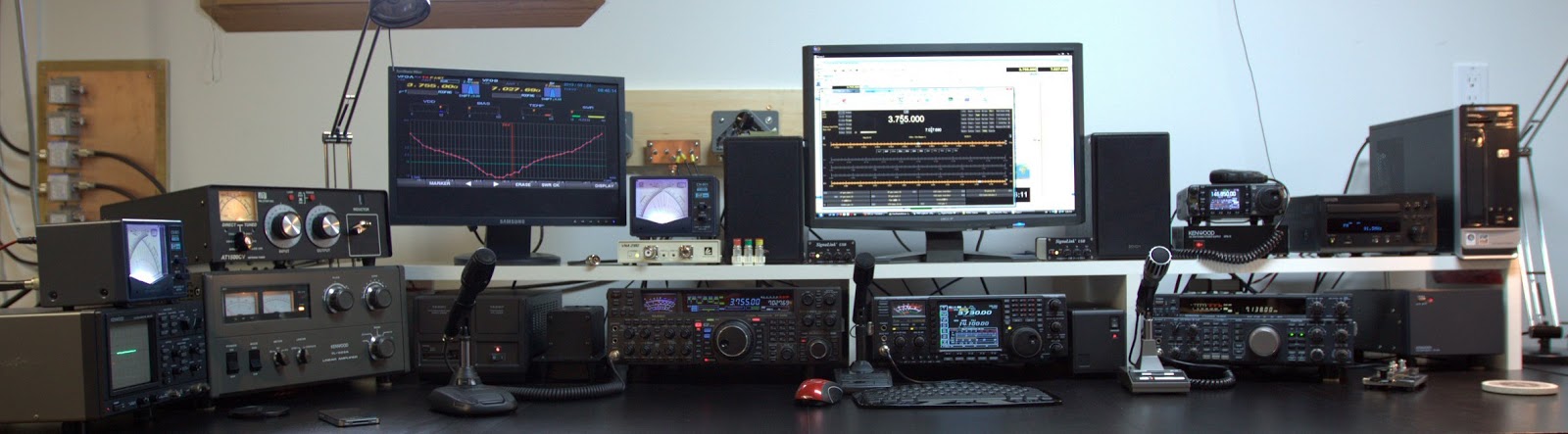
We are here gain.
http://acomeau.blogspot.ca/2012/02/link-to-past-operation.html
The link above, will take you to my post from last year's winter Yurt field operation.
Enjoy.
Adrien
VE3IAC/P
73
Sunday, January 27, 2013
Thursday, November 8, 2012
Can you hear me now!? Kenwood TL-922A
For some time I have had my eye on a few linears, and when this one showed up on eBay recently I could not resist. The Kenwood TL-922A unit was for sale and a weekend trip from Ottawa to Manchester New Hampshire made a safe and enjoyable way to get the unit home.
In the picture below, the amp is shown along side of my father's (VE1JNA - SK) Kenwood TS-850SAT, and these do make a nice pair.
Many folks have commented on the physical build quality of this design, and I will add my comments to the pile-up. I did not confirm when this unit was built, but being of the late 1970's, I can say this 30 year old unit will be here for many years to come because it does not show its age. I was very lucky because the previous owners, and I do not know how many there were, have taken good care of this amp.
I have picked over much of this amp from outside and in, and in terms of modifications, there are only a few.
The bandswitch was ruined and I had half expected this to be the case. I was able to get a new switch from Multi Tech Industries . Although it took me a bit longer to get it in, it was a easy job none the less. You do have to be careful to make sure every thing gets connected back to where it started.
Interestingly, the amp was able to run on all but 20m. A close inspection of the 20m input filtering led me to a pair of mica caps that had been pushed against each other. This caused their leads to cross and touch, shorting out the inductor. Simply fixing this, made the input SWR drop from over 100:1 to 1:1 and 20m was now in business too.
As an example, operating on 40m, the setup below shows 55W in and 650W out. The plate and grid currents are 450mA and 150mA.
Having only had the amp for a few weeks, I know this is going to be a good addition to the shack. If you are in the market for a this piece of Kenwood history, I hope you are able to find an Amp as well cared for as I was able to.
MHz 1.8 3.5 7 14 21 28
Band 160m 80m 40m 20m 15m 10m
Plate 3.5 7 7 14 21 >21
Load 0 1.8 2.2 4 4.2 4.8
Ip (dip) Yes Yes Yes Yes Yes Yes
Ip 480 500 500 500 500 350 (mA)
Ig 200 150 180 175 150 150 (mA)
HV 1900V 1900V 1900V 1900V 1900V 1900V at load
Pout 550 600 700 800 625 435 (W)
Pin 65 55 75 70 55 40 (W)
SWRin 1.5:1 1:1 1.3:1 1:1 1.3:1 2:1
73
Adrien
VE3IAC
In the picture below, the amp is shown along side of my father's (VE1JNA - SK) Kenwood TS-850SAT, and these do make a nice pair.
| Kenwood TS-850SAT and TL-922A |
The TL-922A is a heavy brute coming in at 31kg. Flipping this beast over, when working on it will leave marks on your desk if you are not careful!
The HV supply has two modes which change the plate voltage from 2.2kV to 3.1kV for CW and SSB modes. In SSB mode this amp is specified to generate 1kW out for approximately 80W in. (This is what the curves at the back of the service manual say!)
Call me old fashioned, but if you are like me, then you too believe radios must have plenty of knobs and switches to be interesting. I should add that the metering on the TL-922A also meets my expectations too. I know analogue meters miss the peaks but there is a satisfaction in seeing the physical needle move as you tune up the amp.
| TL-922A Metering |
Many folks have commented on the physical build quality of this design, and I will add my comments to the pile-up. I did not confirm when this unit was built, but being of the late 1970's, I can say this 30 year old unit will be here for many years to come because it does not show its age. I was very lucky because the previous owners, and I do not know how many there were, have taken good care of this amp.
| TL-922A |
| Kenwood TL-922A |
I have picked over much of this amp from outside and in, and in terms of modifications, there are only a few.
- The Tubes are a pair of 3-500Z's from the good folks at RF Parts.
- The suppressors are the original Kenwood items and have not been changed out.
- The 10M band addition was done as described here.
- The HV caps have been replaced with Cornell-Dubilier 210uF 450VDC
- The SS-100 Universal Soft-Start from Harbach was installed
| Burnt Plate Cap? |
| Installed Multi Tech Band switch |
| Shorted input filter for 20m |
As an example, operating on 40m, the setup below shows 55W in and 650W out. The plate and grid currents are 450mA and 150mA.
| 55W in and 650W out |
Having only had the amp for a few weeks, I know this is going to be a good addition to the shack. If you are in the market for a this piece of Kenwood history, I hope you are able to find an Amp as well cared for as I was able to.
MHz 1.8 3.5 7 14 21 28
Band 160m 80m 40m 20m 15m 10m
Plate 3.5 7 7 14 21 >21
Load 0 1.8 2.2 4 4.2 4.8
Ip (dip) Yes Yes Yes Yes Yes Yes
Ip 480 500 500 500 500 350 (mA)
Ig 200 150 180 175 150 150 (mA)
HV 1900V 1900V 1900V 1900V 1900V 1900V at load
Pout 550 600 700 800 625 435 (W)
Pin 65 55 75 70 55 40 (W)
SWRin 1.5:1 1:1 1.3:1 1:1 1.3:1 2:1
73
Adrien
VE3IAC
Sunday, October 21, 2012
VE3IAC/2 et l'île Verte
Welcome.
IOTA NA-128 is an island group in the Quebec province of Canada in the St Lawrence Seaway. IOTA indicates that this island group is well claimed by 43% of participants. l'île Verte is one of many islands in this group which includes a 350km stretch of the St Lawrence Seaway.
With your help we completed 153 QSOs. My thanks goes to all who answered
my "CQ de VE3IAC/2 IOTA NA-128" call. I realize that pileups can be hard
to get through, and I appreciate your patience.
From a volume perspective, notable QSOs are all of those from Europe and Middle East. I am always amazed how many operators there are in Germany.
New for me was Iceland, Aegir Olafsson TF2CT, many 73s to you.
Noel Hammond ZR6DX of South Africa at 12600km was especially nice, 599 both ways.
I must not forget 9000km South America stations in Argentina Horacio Cortadello LU6EHO and Dani Grezzi LW1DG.
The operation station included a Yaseu FT2000D Transceiver running 200W SSB through a Palstar AT1500CV Tuner into a twin lead fed DX Engineering 80m Doublet. 50watts was run on 10m and 20m with a YP-3 Portable Yagi .
The station also used a Icom 756 Pro III Transceiver running 100W SSB through an Icom AH-4 Tuner into the twin lead fed DX Engineering 80m Doublet.
Here is a link from the last time we were here.
http://acomeau.blogspot.ca/2010/04/iota-activation-of-na-128-by-ve3iac2.html
73 OM
Adrien
VE3IAC/2
IOTA NA-128 is an island group in the Quebec province of Canada in the St Lawrence Seaway. IOTA indicates that this island group is well claimed by 43% of participants. l'île Verte is one of many islands in this group which includes a 350km stretch of the St Lawrence Seaway.
![]() |
| NA-128 Island Group |
| QSOs |
New for me was Iceland, Aegir Olafsson TF2CT, many 73s to you.
Noel Hammond ZR6DX of South Africa at 12600km was especially nice, 599 both ways.
I must not forget 9000km South America stations in Argentina Horacio Cortadello LU6EHO and Dani Grezzi LW1DG.
The operation station included a Yaseu FT2000D Transceiver running 200W SSB through a Palstar AT1500CV Tuner into a twin lead fed DX Engineering 80m Doublet. 50watts was run on 10m and 20m with a YP-3 Portable Yagi .
| VE3IAC/2 Operating Station at Ilse Verte NA-128 |
| VE3IAC/2 Operating Station at Ilse Verte NA-128 |
| YP-3 setup for 10m Operation |
| The view facing Europe. |
| Lighthouse on the North Shore |
Here is a link from the last time we were here.
http://acomeau.blogspot.ca/2010/04/iota-activation-of-na-128-by-ve3iac2.html
73 OM
Adrien
VE3IAC/2
Thursday, September 13, 2012
Nirvana, MoonLite and M27
It has been a while, too long in fact, since I have been under worthwhile dark skies. I had heard rumors of a place called Nirvana. Sounds like a nice place, and it was indeed.
Nirvana is a dark sky location, where "OAFs go when they have earned enough observing karma". It is also known as the Irvine Lake Airstrip. Near Bon Echo Provincial Park. The site is a tidy 2.5hr drive from Ottawa at 45° 1'47.64"N 77°15'50.53"W and is in a cozy little dark sky pocket dew west of the city.
The air strip is usually a peace full place, but I would suggest that if these folks beat you there, you might not get much sympathy asking for "red lights please?". army.forces.gc.ca @ Nirvana
I have had my scope for several years. The main scope is a Celestron C11, on a CGE mount with a William Optics Megres 90mm refractor piggybacked. Both scopes provide excellent visual as well as photographic performance. Either can be used for guiding while imaging with the other. It is a pleasure to have both together because the WO90's field of view is so generous compared to the higher magnification powers of the C11.
The new toy, is the moonlite focuser with High Resolution Stepper Motor with MoonLite Mini Controller options. Software was changed up to
The CCD camera is the QHY8, which I have described in another post.
I admit I had a devil of a time getting my goto's to be as good as they usually are and spent a good deal of the time wondering where my objects were! After thinking it through the next day I'm convinced I must have not adjusted the balance well enough and it was the extra weight of the focuser throwing the slews off. I will be more carefull next time.
The end result of the evening was a single image of M27, an object I have done before. I was very pleased maxFocus, and MoonLite focuser was able to find focus better than I have ever done in the past by hand.
Image Info.
QHY8 at f/10 on C11 captured 15 x 200sec images for a total of 50min and were stacked in maximDL.
Autoguided with Orion StarShoot AutoGuider on WO 90mm.
Dark skies...
Adrien
Nirvana is a dark sky location, where "OAFs go when they have earned enough observing karma". It is also known as the Irvine Lake Airstrip. Near Bon Echo Provincial Park. The site is a tidy 2.5hr drive from Ottawa at 45° 1'47.64"N 77°15'50.53"W and is in a cozy little dark sky pocket dew west of the city.
![]() |
| Nirvana |
The evening sky showed exactly the right number of clouds.
| Blue Skies |
When I left town I was unsure if I would have company so I brought my pal along with me.
| My pal Kayleigh |
I have had my scope for several years. The main scope is a Celestron C11, on a CGE mount with a William Optics Megres 90mm refractor piggybacked. Both scopes provide excellent visual as well as photographic performance. Either can be used for guiding while imaging with the other. It is a pleasure to have both together because the WO90's field of view is so generous compared to the higher magnification powers of the C11.
![]() |
| Celestron C11 w/ Willam Optics 90mm on CGE Mount. |
The new toy, is the moonlite focuser with High Resolution Stepper Motor with MoonLite Mini Controller options. Software was changed up to
| Moonlite Focuser |
The CCD camera is the QHY8, which I have described in another post.
I admit I had a devil of a time getting my goto's to be as good as they usually are and spent a good deal of the time wondering where my objects were! After thinking it through the next day I'm convinced I must have not adjusted the balance well enough and it was the extra weight of the focuser throwing the slews off. I will be more carefull next time.
The end result of the evening was a single image of M27, an object I have done before. I was very pleased maxFocus, and MoonLite focuser was able to find focus better than I have ever done in the past by hand.
Image Info.
QHY8 at f/10 on C11 captured 15 x 200sec images for a total of 50min and were stacked in maximDL.
Autoguided with Orion StarShoot AutoGuider on WO 90mm.
![]() |
| M27, Dumbell |
Dark skies...
Adrien
Labels:
Astronomy,
Astrophotography,
moonlite,
nirvana
Monday, February 27, 2012
2012 Silent Lake DX expedition
Thanks for visiting, this post is for another trip to Silent Lake. This trip was especially nice for a few reasons. My work takes me away from home on occasion, and I had just returned from Stockholm. Roxanne and I love time we spend together and this was a nice way to slow down a bit and enjoy each others company. On the other hand, the real reason, (but don't tell her!) is that I get to play radio once again.
Silent Lake is a provincial park in the central south Ontario.
This park has a number of Yurts for daily rental, more information on these can be read at http://www.ontarioparks.com/english/silentyurt.html . The more notable items that are provided by the park at each Yurt are;
- Two sets of bunks beds, sleeping 6 or more (depends on how cozy you want to be!)
- Heating is by wood burning stove, with a endless supply of wood that splits very easily
- Propane barbecue, this is truly nice.
Entry into the park, starts with your personal vehicle but does not end there, because you can not drive to the yurts, even though the yurts are on the normal campground road system. The park Ranger takes you and your stuff the last 1 to 2 km into the park with a ride in a mini bombardier and a pair modified sleighs.
At the site we were welcomed the next morning by a doe and her two yearlings. The park ranger had told us that there was a threesome that was wandering the park, but for the past few days, they had not seen them all together. It was nice to see that nothing had happened to them.
On the radio front, the important bits of the setup was the usual stuff.
- Icom 7000 transciever (100W)
- Icom AH-4 antenna tuner
- DX Engererring 80m doublet
- Battery Booster
- 4 50AH AGM batteries
| IC-7000 100W Transceiver |
| Icom AH-4 Tuner |
| 80m Doublet (feed line at least) |
| Battery Booster |
| The Batteries |
| The Silent Lake HF Station |
The best contact of the trip, was to Frank Schoombie's South African station ZR6RC. This was done on 15m, at mid day, in BPSK-31 mode. He answered my call and I almost fell off my chair. I would imagine this QSO hit the water a few times making its way nearly half way around the world. Thanks Frank for being there.
Now, the next new thing for me was to notice that ONTARS needed a controller Tuesday afternoon in the 2PM slot. With some reservation, I threw my call in the hat and away I went. You can see may name there at 2PM, as soon as Barry ISX updated the ONTARS website I knew there was no turning back!
Well, the hour went very fast and I was pleased it went well. I did not run out of power, I did not make to many mistakes, and most of all it was a blast. I enjoyed answering the many questions that helped folks understand where I was and the station setup.
| ONTARS, ONTARS,... |
I know there was one check in I missed to log at the start and for this I am truly sorry. Thanks to all who checked in with me.
- VE3CAK John
- VE3ISX Barry
- VA3ZW James
- VE3FAS Philip
- VE3NJV Nick
- VE3ODT Don
- VE3GGP Harry
- VE3ZP Pat
- VE3XDJ Rich
- VA3HRH Handiradioham Amateur Radio Club of Canada
- VE3BWQ Allan
- VE3UFO John
- VE3MDL Marcus
I guess I better press the "Publish" button on this post. I look forward to the next DX expedition in the heart of Ontario or other place, and look forward to seeing everyone again.
73
Adrien
VE3IAC/P
Below is a post of a previous winter DX expedition is at the link below.
http://acomeau.blogspot.com/2010/02/silent-lake-yurt-dx-expedition-field.html
Labels:
Amateur Radio,
Portable Operation
Sunday, November 20, 2011
10M band RFD Resonant Feedline Dipole Report
Well, it works!
A few weeks ago I made up a resonant feedline dipole for 10M as an experiment and the initial measurements looked good,. (Post http://acomeau.blogspot.com/2011/10/10m-band-rfd-resonant-feedline-dipole.html ) This weekend I used the ARRL sweepstakes contest as a way to get a few quick test QSOs in.
| 10M RFD |
I threw the end of the antenna up in a maple tree in the back yard, connected up a spare feedline into the house and tuned the antenna up.
The bottom of the 10M band looks good, with SWR <1.5:1. The upper end of the band is just as well.
![]() |
| 10M Band SWR |
![]() |
| 10M SWR |
I ran a few QSOs in the contest, as well as a few DX QSOs into Europe. The listing below are the local and DX contacts. 6000km is not too bad for a few meters of RG-174 and automotive wire. I was running the FT2000D (100W+ PEP SSB or 20W PSK)
![]() |
| First Contacts |
![]() |
| PSK Reporter |
Humm, so I guess all that is left is to forge ahead with the full 80m version hung from a kite skyhook!
73
Adrien
Labels:
Amateur Radio,
Antenna,
Resonant Feedline Dipole,
RFD
Tuesday, October 18, 2011
10M band RFD Resonant Feedline Dipole
I am interested in experimenting with antenna designs, and those that have properties which make them useful for temporary field usage are interesting.
This post is about the construction and measurements of a Resonant Feedline Dipole cut for the 10M band.
The central feed point of the dipole is the open end of the coax . The extended center conductor acts as one half of the dipole. The coax's shield from the "open end" back to the common mode choke acts as the other half of the dipole. Power is delivered to the feed point within the coax its self in the usual way coax transfers power. The choke's distance and extended conductor's length are selected in the usual way.
| 10M Resonant Feedline Dipole |
| Center with temporary strengthening strain relief. |
| 5 turn Choke |
| VNA 2180 |
![]() |
| Full Sweep 1MHz to 30MHz showing resonance in 10M band |
SWR is the red line in the above figure and the length 7ft 8.25in resulted in resonance being placed in the middle of the 10M band.
The smith chart below shows the input impedance with the antenna connected directly to the analyzer. The second chart shows the change in input impedance with an extended (25ft) feedline. The observation that the impendence versus frequency is somewhat similar asside from a rotation around the chart illustrates the the choke is nearly sufficient to "cut off" the sheld dipole arm.
![]() |
| 10M RFD with short (6ft) feedline |
![]() |
| 10M RFD with long (25ft) feedline |
I connected up the iCOM IC7000 and verified that it too saw the same SWR as the VNA.
I can foresee that this form of antenna could be quite handy. It is very simple, light weight and easy to put up either as a sloper, flat top, or even a vertical. Other bands will need seperate versions, obvious changes are needed to strengthen the center connection and higher choke inductance is needed, espically at lower bands.
73
VE3IAC
Labels:
Amateur Radio,
Antenna,
Resonant Feedline Dipole,
RFD
Subscribe to:
Posts (Atom)